

How To Choose a Backpack for Round The World Travel
By Lloyd C | Updated October 11th, 2010
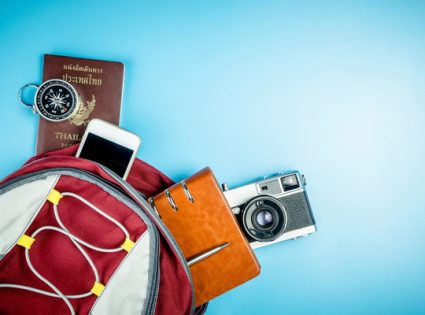
This isn’t one of those ‘How To Choose a Backpack‘ guides that present millions of options for hundreds of scenarios. No, instead, I want to give you very few options based on my personal experience with just one scenario, for how to choose a backpack for round the world travel.
No matter how many guides you read, it will take at least one solid week on the road to know what makes a good travel backpack. But by letting you in on the secrets of my own mistakes, hopefully, you’ll be able to make a more informed decision from the outset.
First Things First
Most backpack manufacturers include the size (or capacity) of their packs in the model numbers. The typical capacity metric is liters. So when you see the Deuter Futura 32, you can assume the pack has 32 liters of capacity. Of course, many manufacturers and retailers in the USA haven’t cottoned on to the metric system, so they still report backpack capacity as cubic inches. Nonetheless, you can use Google to decipher ci’s for L’s. Just type the following (replacing 1000 for the number you want to convert) into Google and click
Search: convert 1000 cubic inches to liters

Our Mistake #1: two packs that are 30 liters don’t necessarily fit the same amount of gear. The shape of the pack can make a big difference in the arrangement (and hence amount) of gear you can carry. I recently purchased a 32-liter pack over the Internet after viewing a similar 28-liter pack. But the 32-liter pack fits much less gear due to its shape.
Carry-On Limits
Lauren and I (try to) travel with carry-on baggage only. What that means is our backpacks are small (and light) enough for airlines to allow them into the cabin of the plane. There are many direct advantages of carry-on-only, such as airlines not losing your bags, and many indirect advantages, such as being forced to pack lightly and not buying too much while abroad.
Airlines have different carry-on restrictions, but for most flights, you’ll be safe with the following:
55cm (22in) x 35cm (14in) x 23cm (9in) and ~7kg.
These dimensions equate to a capacity of about 44 liters. So keep this in mind if you subscribe to the carry-on-only philosophy.
Our Mistake #2: the difficult part of carry-on-only is not the dimensions, but the weight. I can fit all of my gear into a 32-liter bag, but its weight comes in at almost 10Kg. Even with a 10Kg bag, I’ve only been asked to check it once on a domestic flight from Lima to Cusco (Peru).
Trekking Packs Only
It can be tempting to opt for designer totes, shoulder bags, and professional cases, but after ten minutes of dodging traffic in a foreign locale, your shoulders and back will murder you for it. Even if you only plan to visit developed countries, you’ll still spend a lot of time walking with your pack.
There is simply no alternative to…
a well-made trekking backpack with an internal frame, padded shoulders, a thick padded waist-belt, integrated rain cover, and back-panel ventilation.
You can try to convince yourself that you won’t be walking much, but if you’re even mildly adventurous, you’ll be walking all the time.

Our Mistake #3: Lauren and I sold our trusty trekking packs after Kilimanjaro for more professional bags. I bought the Tom Bihn Tri-Star and Lauren bought The North Face OnSite. Both had backpack straps, but neither was designed to carry heavy loads, even over short distances. It only took one day walking around Montreal looking for a hostel to realize we’d made a mistake.
How To Choose a Backpack
You don’t have to adhere to the carry-on only philosophy, but minimalism rules when it comes to round-the-world travel. Why? Because having less to carry and less to think about gives you more energy for exploration and enjoyment.
Step 1. Select Type
As aforementioned, you want a trekking backpack. Not a climbing pack, not a summit pack, not a snow-sports pack, but a trekking pack. It must have a thick waist belt and a contoured back. Many travelers extol the virtues of panel-loading packs (where the front opens up like a suitcase), but this feature is rare in trekking packs. Plus, top-loading designs allow for more stuffing and are generally more durable.
Manufactures of good trekking packs include Deuter, Arc’Teryx, Osprey, Berghaus, and Lowe Alpine.
Step 2. Select Size
If you plan to carry-on only, you’ll need a bag 40 liters or less. In fact, even if you’re not planning to carry on, I still wouldn’t go for a bag much bigger. You want to feel comfortable, but this is a good chance to decide what makes you comfortable and not just take everything ‘just in case‘.
I take the following with a 32-liter bag (wearing some of the clothes):
3 x t-shirts, trekking shirt, formal shirt, a pair of cufflinks, jeans, trekking pants, 5 x underwear, 4 x socks, set of pyjamas, fleece lined jacket, thermal underwear, beanie, hat, 13inch Macbook Pro, external harddrive, compact camera, Amazon Kindle, electronic language dictionary, cell phone, charges and cables, lots of toiletries, a -10C down sleeping bag, rain jacket, plastic poncho, flip flops, Gortex hiking boots, Moleskine and pen, and much more.
As you can imagine, my bag weighs a tonne! Or close enough, about 10Kg. So capacity can be deceiving, but I still prefer to have it all in a smaller bag so I can walk the streets without knocking people over and so I carry the bag on my lap if needed (which is often, especially on public transport in developing countries).
Step 3. Select Features
Once you select your type of bag and ideal size, you’ll be left with maybe 10 to 15 different backpacks. Let’s not kid ourselves, at least half of those packs won’t be to your liking (looks, shape, color, etc.). There’s nothing wrong with not liking the color or shape of a pack, we’re all human, and you’ll get more enjoyment out of a pack that you like.
Let’s say, based on look and feel, you’re now down to 3 to 5 packs. How do you choose between them? Features! Your backpack will be your home for many weeks, if not months, so features aren’t just luxuries, they’re conveniences, safety, and enjoyment.

The following is a list of features are important in any ‘How To Choose a Backpack’ guide. The list isn’t exhaustive and not all these features are important to me, so pick and choose as you find necessary.
- Integrated rain cover: useful if you plan multi-day hikes in tropical areas, overkill for light rain in the city. Also, a handy protector if you plan to check your bag.
- Waist belt pocket: for easy access to sunscreen, lip balm, and trail mix
- Thick waist belt: always useful, helps to carry heavy loads, reduces stress on shoulders
- Back ventilation: reduces sweating, but gives a curved shape = harder to pack
- Water resistant material: a must for light rain; doesn’t have to be fully waterproof
- Internal pockets: a must for storing valuables and items very susceptible to rain damage
- Sternum strap: helps to keep shoulder straps together and to balance the load
- Water bladder storage: not really necessary for RTW travelers (water inside your bag can be a disaster) but some of them are the perfect sizes to carry a laptop
Yay for eBay!
I mentioned, in the beginning, you need at least a solid week with a backpack until you know if it’s right for you. So what happens if the bag, which fit well in the shop, just didn’t cut the mustard in practice?
Well, sell it on eBay. You don’t need to make life difficult when abroad, and you certainly don’t need back injuries, so don’t settle for second best. You may lose a few dollars, but I’d gladly miss a few meals to save on back pain and other hassles.
We’ve been away for almost 4 months now and it just wouldn’t have made sense for me to keep struggling with my old Tom Bihn bag. So I put it on eBay in Montreal, ordered my current bag from the US, and now I’m a happy camper.
Recommendations
Deuter Futura 32
This is my current backpack, and I absolutely love it, but some days it seems a little small. With that said, I am carrying a sleeping bag at the moment, so when I get rid of that, it will be perfect. The Futura 32 has an integrated rain cover, excellent back ventilation, lots of useful pockets, a very supportive waist belt, and lots more.
Arc’teryx Axios Backpack 35
This is Lauren’s current backpack, and some days, I wish it were mine. It seems a lot bigger (even though it’s only 3 liters bigger) and its shape is better for packing. However, it doesn’t have an integrated rain cover and it doesn’t have nearly as good back ventilation, which is the reason it has a better shape for packing.
Osprey Kestrel 38
I almost bought the 228-later version of this bag, which seemed larger than my Futura 32, but it has one serious problem. There is no real internal support, so the bag is one big noodle. However, the larger 338-lighter model has great internal support and lots of great features. I would buy this bag if it weren’t for the Deuter Futura series.